Long-Term Partnership vs One-Off Translation: What Scales Better for Global Growth?
While one-off translation solves immediate needs, long-term language partnerships build the institutional knowledge, scalability, and strategic alignment global businesses depend on.
When companies first outsource translation, it often begins with a single project. A product manual. A contract. A marketing brochure.
The engagement is often transactional and the objective is simple: deliver the files, meet the deadline, move on.
But as businesses begin to expand internationally, something shifts. Translation stops being a task and starts becoming a permanent part of business infrastructure.
And that is when the difference between a one-off translation vendor and a long-term language partner becomes strategically significant.
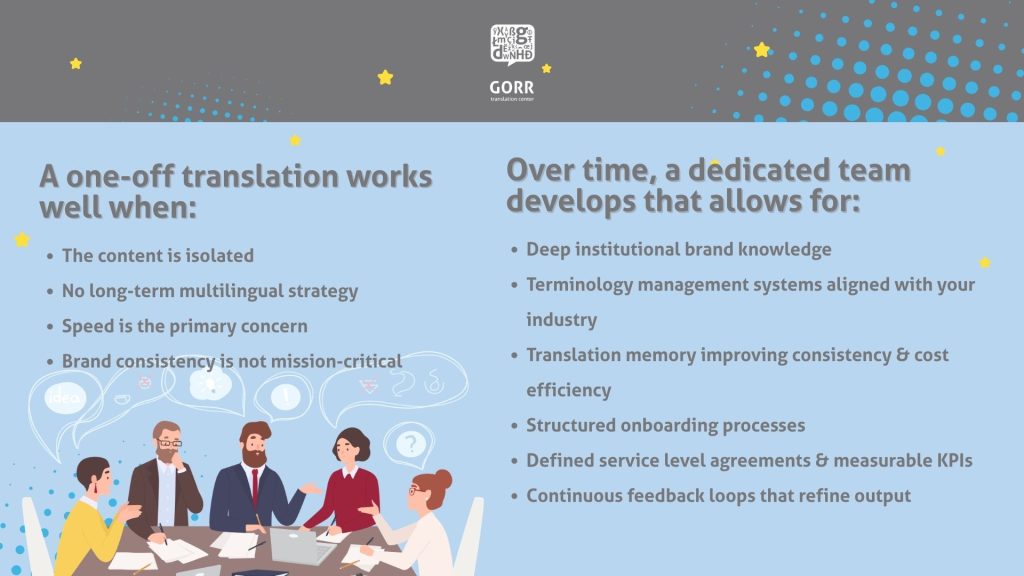
In this model, the relationship is transactional. Each project begins with onboarding, context rebuilding, terminology clarification, and brand voice interpretation.
The hidden cost is repetition. Every new project essentially resets the learning curve, particularly if businesses are constantly jumping from one LSP to another.
Without institutional knowledge, terminology memory, or consistent project management, variability becomes inevitable. Tone shifts, approved terminology drifts, and quality fluctuates, depending on who handles the project.
For occasional needs, this may be sufficient.
However, for scaling global businesses, such inconsistency becomes inefficient.
The Long-Term Language Partnership Model: Infrastructure for Growth
A long-term partnership has the potential to transform translation from a reactive service into a strategic advantage.
Rather than restarting each time, you build momentum. Over time, a dedicated team develops that allows for:
Deep institutional knowledge of your brand
Terminology management systems aligned with your industry
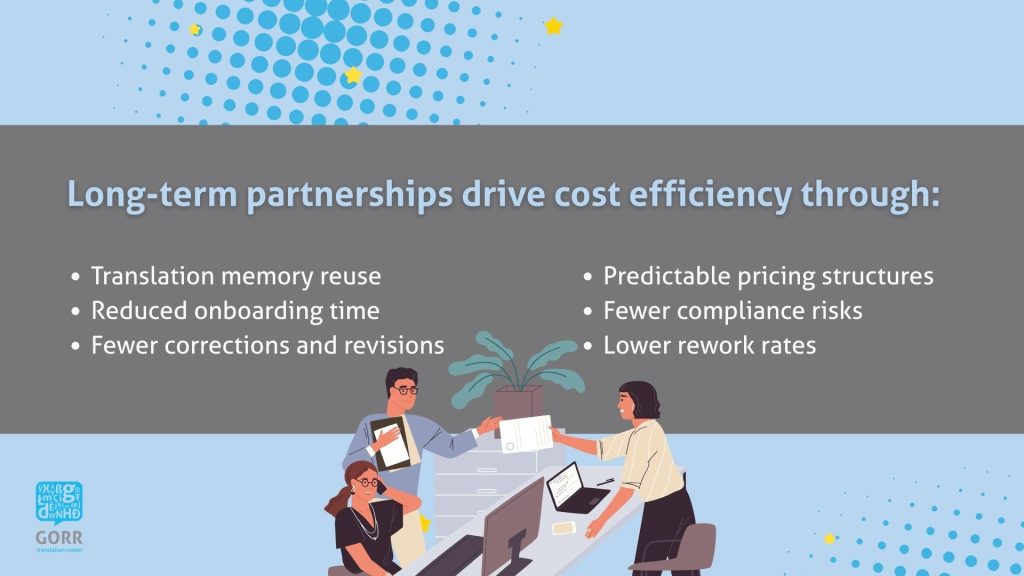
Translation memory assets that improve consistency and cost efficiency
Structured onboarding processes that reduce friction
Defined service level agreements with measurable KPIs
Continuous feedback loops that refine output
Translation then stops being a recurring expense and instead becomes an optimized system.
Institutional Knowledge Is a Competitive Advantage
When the same linguists and project managers have the opportunity to consistently work on your content, they internalize:
Your brand voice
Your preferred phrasing
Regulatory sensitivities
Market positioning
Product evolution
Cultural adaptation standards
This accumulated expertise cannot be replicated in cases of ad-hoc vendor rotation.
It compounds.
And compounding knowledge reduces risk, accelerates turnaround, and improves quality and consistency.
Strategic Alignment vs Transactional Exchange
In a transactional model, the LSP delivers words.
In a partnership model, the LSP aligns with your business goals.
Vendor rotation increases exposure because no single provider retains full context.
Risk decreases as knowledge accumulates.
The Trust Factor
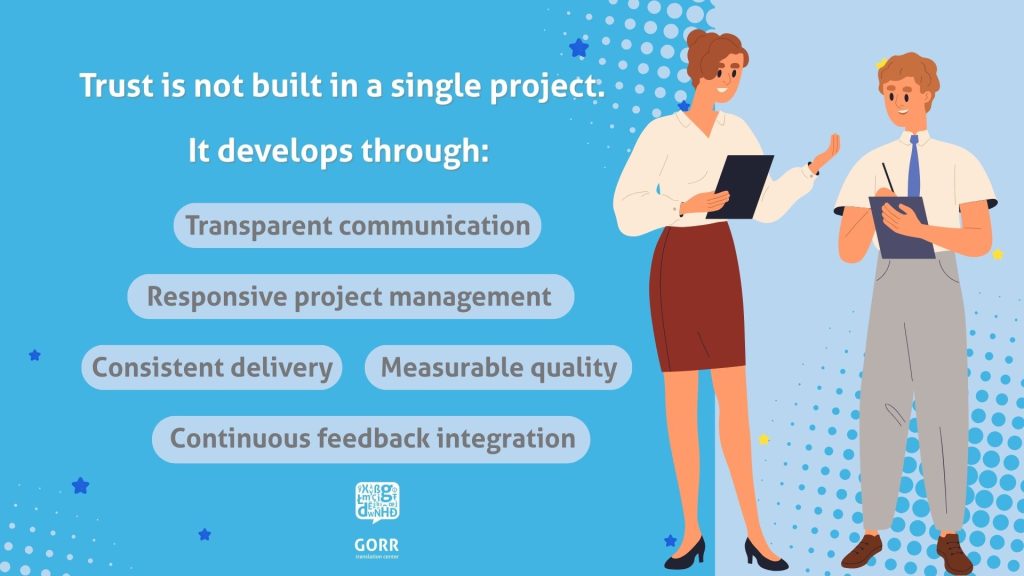
Trust is not built in a single project.
It develops through:
Transparent communication
Consistent delivery
Measurable quality
Responsive project management
Continuous feedback integration
Over time, a trusted language partner becomes an extension of your internal team.
That level of alignment cannot be replicated in a purely transactional relationship.
When Does One-Off Translation Make Sense?
There are valid scenarios:
Internal-only documents
Non-recurring needs
Experimental market testing
Low-risk materials
But for organizations with ongoing multilingual operations, one-off models often create fragmentation.
Final Perspective: Translation as Infrastructure, Not Interruption
The question is not whether one-off translation works. It does. The question is whether it supports sustained global growth.
When translation becomes part of your operational backbone, a long-term partnership delivers scalability, consistency, cost efficiency, and strategic alignment.
And in competitive international markets, infrastructure always outperforms improvisation.
Translation Quality & Accuracy: What B2B Buyers Really Need (and Why It Still Requires Humans)
Translation quality isn’t just about accuracy—it combines consistency, cultural context, fluency, and human-led QA to ensure B2B content is reliable, professional, and market-ready across global audiences.
A remote translation team is a global network of specialized linguists, project managers, and QA experts who use advanced tools, cultural insight, and clear communication to deliver accurate, consistent, and market-ready translations across time zones.