What if the whole world suddenly spoke the “same language”, instantly, effortlessly, at the tap of an AirPod or the click of a Google Meet button?
Tech giants want you to believe this future is already here. But for global businesses, the real question isn’t Can AI translate in real time?
It’s:
Can AI translate well enough to protect your brand, avoid cultural misfires, and deliver content you’d confidently stand behind?
And that’s where things get complicated.
The New Wave of AI Translation Tools: Impressive, Fast… and Flawed
Google, Apple, Meta and others are racing to build real-time translation features that capture your voice, mimic your intonation, and instantly output another language.
It sounds like the industry is on the brink of eliminating language barriers entirely.
But here’s what the headlines don’t say…
Real-time AI translation works beautifully on a stage.
It struggles everywhere else.
Experts in linguistics, psychology, and NLP warn that as soon as conversations get messy (interrupted speech, sarcasm, cultural nuance, domain-specific terminology, etc.) AI models begin to unravel.
And businesses are the ones that often feel the consequences.
Why Real Conversations Break AI Translation (and Why That Matters for Companies)
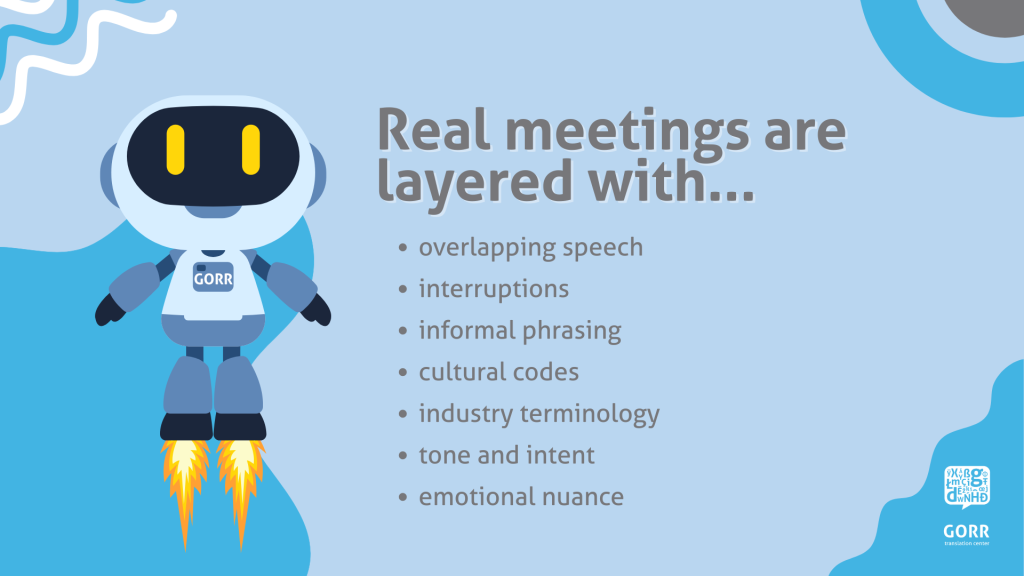
Real meetings aren’t clean, turn-based monologues. They are layered with:
- overlapping speech
- interruptions
- informal phrasing
- cultural codes
- industry terminology
- tone and intent
- emotional nuance
And current AI tools can’t reliably interpret these signals resulting in mistranslations that sound fluent but miss the point.
For global companies, this isn’t just inconvenient.
It’s a risk.
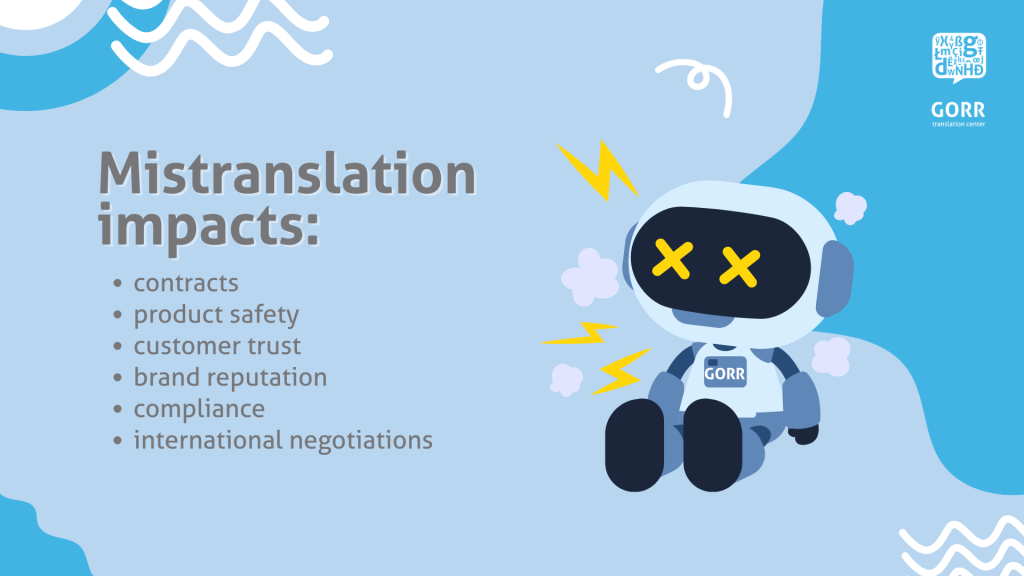
Mistranslation impacts:
- contracts
- product safety
- customer trust
- brand reputation
- compliance
- international negotiations
And yet, AI translation does have its place in modern workflows. It just needs the right guardrails.
Hidden Risks: When Translation Tools Inherit Bias, Formality Errors, or State Media Influence
One of the largest concerns with AI translation tools is training data bias.
If a model is trained on politically skewed, overly formal, or culturally narrow texts, it reproduces that tone in translation, even in contexts where it feels inappropriate or incorrect.
Real examples documented by journalists and researchers show:
- Mandarin translations sounding like state-media writing
- honorifics misused in everyday speech
- casual questions turning culturally offensive or confusing (“Do you have a toilet in your house?” instead of “Where is the washroom?”)
- Turkish translations turning homophones into embarrassing mistakes
These aren’t bugs.
They are structural limitations.
And they directly affect how your business sounds in another language.
Real-Time AI Translation ≠ Professional Translation
Even when AI gets “the words right,” it doesn’t get the meaning, tone, or intent right.
It cannot understand:
- humor
- irony
- sarcasm
- idioms
- industry jargon
- emotional subtext
- legal or medical implications
AI tools are phenomenal assistants, but they are not, and cannot be, specialized linguists, industry experts, or cultural interpreters.
That’s why GORR doesn’t treat AI as a replacement.
We treat it as a starting point.
Where GORR LSP Stands: Quality Over Hype
At GORR, we embrace technology, but with responsibility, human oversight, and uncompromising quality At GORR, we embrace technology, but with responsibility, human oversight, and uncompromising quality control.
Unlike many LSPs, we do not offer “light post-editing.”
Because “light” editing is simply polishing machine mistakes, not fixing them.
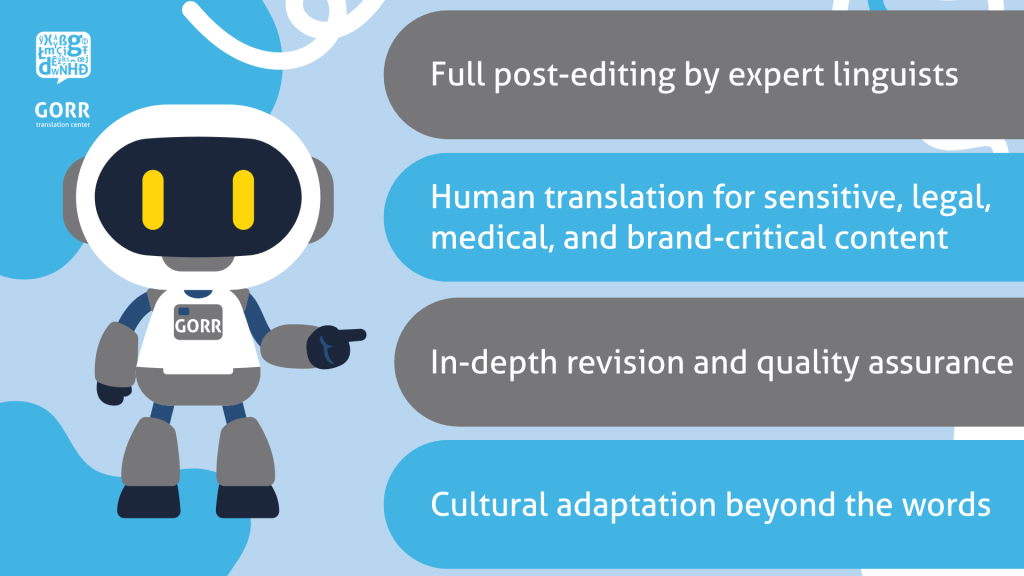
Instead, we commit to:
Ensuring accuracy, fluency, cultural alignment, and industry correctness.
Human translation for sensitive, legal, medical, and brand-critical content
Where nuance, compliance, and tone matter.
In-depth revision and quality assurance
A second linguist + QA specialist ensures consistency and correctness.
Cultural adaptation beyond the words
So, your message sounds like it was written for your audience, not machine-transferred from somewhere else.
AI + Humans = The Only Reliable Path for Global Brands
The future of multilingual communication isn’t AI or humans. It’s both.
AI can help with:
- speed
- draft versions
- large-volume preprocessing
- terminology extraction
- transcription
But the final mile (the part your customers see) must be crafted by humans who understand:
- culture
- context
- brand voice
- industry-specific risks
- legal implications
- emotional nuance
Because “fast” is only valuable if it’s also right.
Why This Matters for Global Businesses Today
If you rely solely on real-time AI translation, you risk:
- misrepresenting your brand voice
- confusing or offending international customers
- publishing inaccurate or risky information
- losing trust in regulated industries
- making cultural errors that harm market entry
- damaging long-term reputation
And your global audience won’t blame your AI.
They’ll blame you.
The GORR Advantage in an AI-Driven World
As AI grows in capability, global companies don’t need more tools. They need better partners.
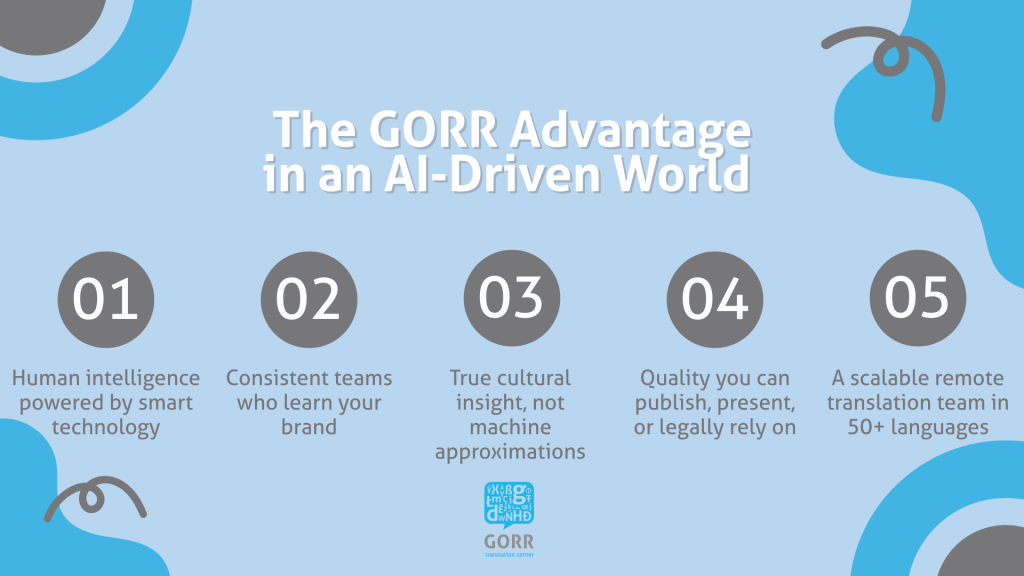
GORR gives you:
Human intelligence powered by smart technology
Not the other way around.
Consistent teams who learn your brand
Increasing accuracy with every project.
True cultural insight, not machine approximations
Because nuance is the real language of global business.
Quality you can publish, present, or legally rely on
Without fear that AI hallucinations or biases have slipped through.
Seamless workflows across time zones.
Use AI Tools, But Trust Human Expertise
Real-time translation is an exciting leap forward.
But for companies operating across borders, the stakes are too high to rely on speed alone.
AI helps you communicate.
Humans ensure you are understood.
If your content needs accuracy, cultural fluency, and brand consistency, GORR ensures you don’t just cross languages; you truly connect with your audience, globally.